Inside Y Combinator: Analysis of 400+ Startups and Market Trends

A concise, step-by-step guide inspired by the WikiHow reading experience.

Admin Desk
Admin Desk
Last updated4 min readHow-to
Inside Y Combinator: Analysis of 400+ Startups and Market Trends

Start with the overview

From saturated domains to untapped opportunities — the data every founder needs to see before choosing their market.

I analyzed every single company in YC’s 2025 cohorts and found something shocking: the biggest opportunities aren’t where everyone’s looking.

Most AI founders are building in markets with 90+ competitors. But I discovered entire billion-dollar industries with fewer than 3 AI startups total.

With this analysis, I wanted to understand:

  • what problems people are solving,
  • what type of AI agents are being built,
  • which industries are the most common and get easily accepted in YC,
  • which industries are oversaturated,
  • gaps(opportunities) are worth exploring,
  • latest tech people are developing,
  • positioning strategies used by winners,
  • how to validate idea looking at the selected companies.

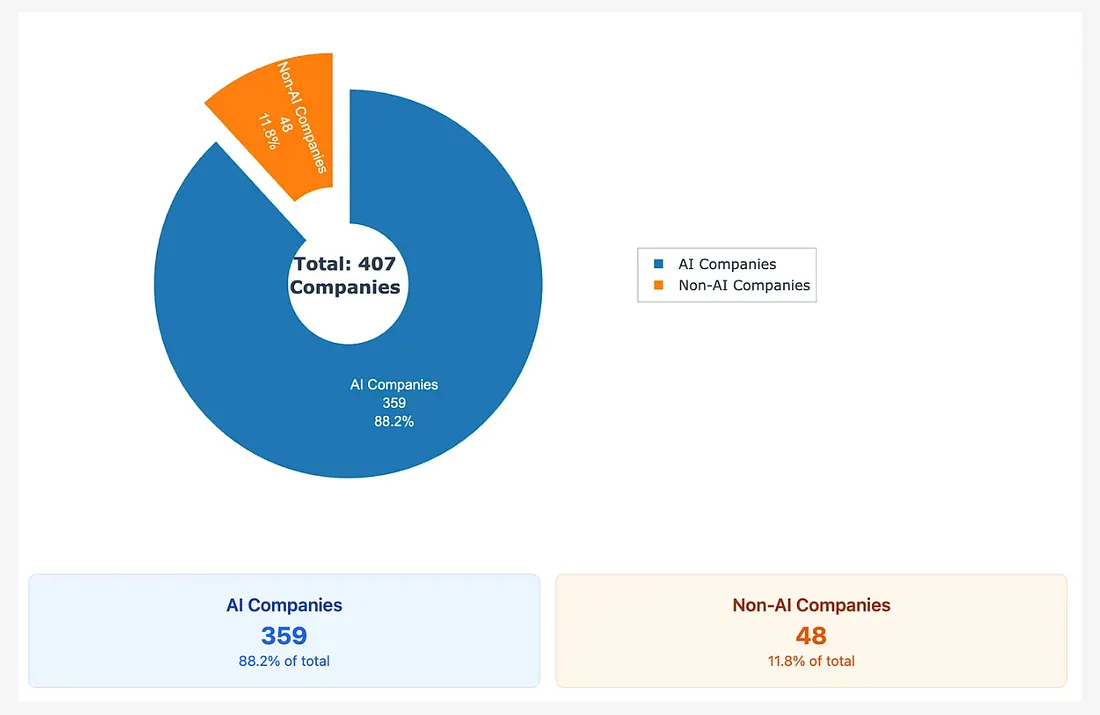
While 88% of founders are building AI companies, most are fighting brutal competition in oversaturated markets.

Developer tools alone attracted 94 companies — that’s one new competitor every 4 days.

But here’s what’s shocking: the biggest opportunities aren’t where the crowds are.

We found entire billion-dollar industries with almost zero AI competition.

  • Government tech has 600+ billion in spending but only 1 YC company.
  • Insurance processes 1.4 trillion annually with virtually no AI startups.
  • Construction wastes 2 trillion yearly on delays that AI could easily prevent.

Companies succeeding in crowded markets aren’t winning with better algorithms. They’re winning by understanding one industry deeply instead of trying to solve everything for everyone.

This complete analysis shows you exactly which markets are oversaturated, which are wide open, and how 16 companies positioned themselves to dominate despite fierce competition.

If you’re building an AI company, you’ll find this analysis super insightful.
AI vs Non-AI

AI vs Non-AI
Almost 90% of the companies are building with AI which clearly tells you that you’ve got to be solving problems with AI.

YC is focusing more on AI apps that are NOT assistants rather are building AI systems that completely replace expensive job functions like legal analysis, accounting, or customer service

Distribution by Business Model

Distribution by Business Model

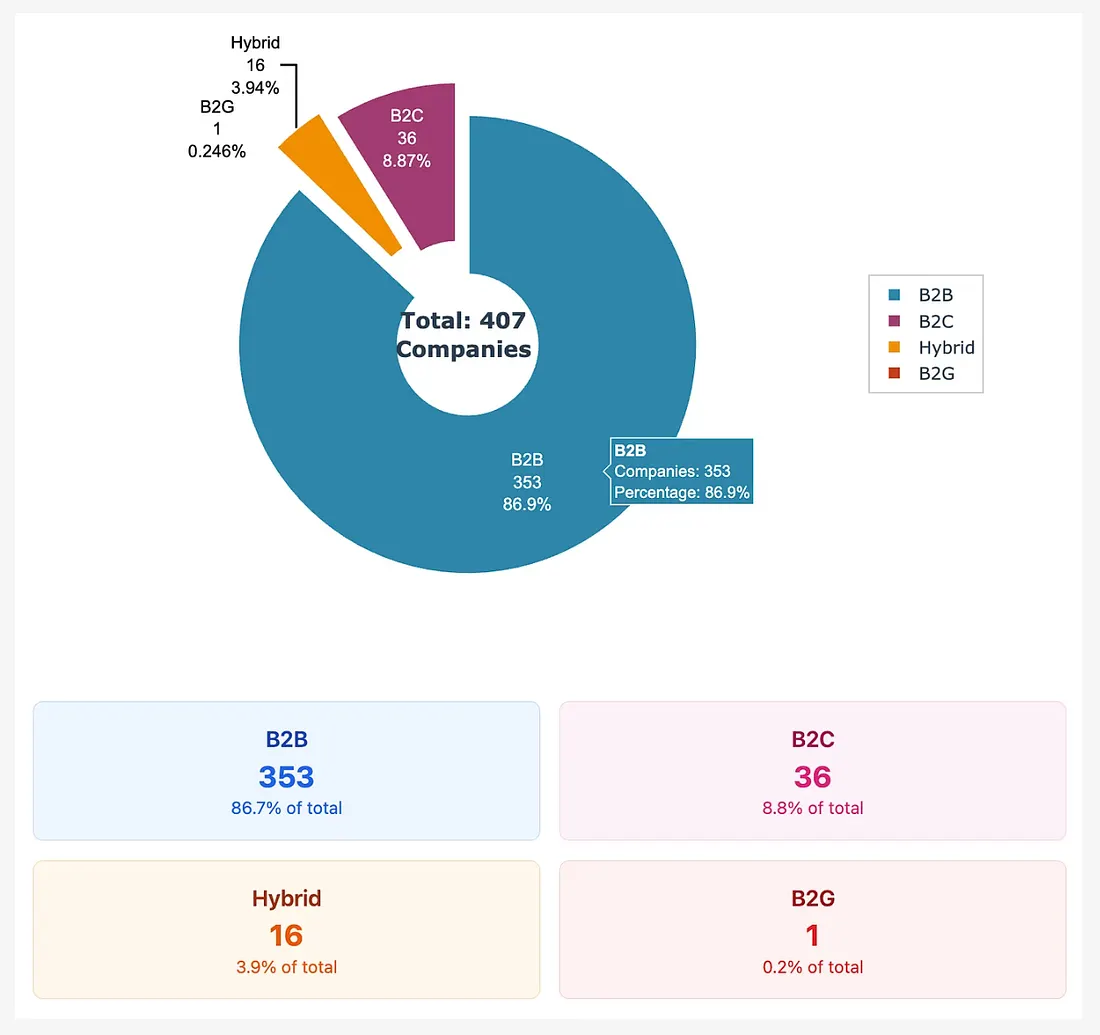
It is very clear that YC prioritizes B2B startups because they offer clear enterprise monetization paths.

B2B Companies (353 total)

  1. Modelence — All-in-one TypeScript platform for startups (developer tools, infrastructure)
  2. Avelis Health — AI-powered medical claims auditing for self-insured employers and health plans
  3. PARES AI — AI platform helping commercial real estate brokers find and close more deals
  4. Pangolin — Open-source secure gateway to private networks
  5. Golpo — AI video generation model for explainer videos from documents

B2C Companies (36 total)

  1. April — Voice-powered AI assistant for managing email and calendar hands-free
  2. Riff — AI-powered music editor for experienced producers and hobbyists
  3. Pingo AI — AI companion for language learning
  4. RealRoots — Mobile app that guarantees women lifelong friendships through AI matching
  5. Opennote — Interactive AI tutor providing personalized learning experiences

Hybrid Companies (16 total)

  1. Pond — AI-native messaging app that works with existing services like iMessage
  2. Vulcan Technologies — AI services for both government regulatory drafting and industry compliance
  3. Wisp AI — Executive assistant for everyday users, small business owners, and employees
  4. Veritus Agent — AI agents platform for loan servicing (serving both lenders and consumers)
  5. Pally — AI Relationship Management Platform serving both consumer and business markets

B2G Company (1 total)

  1. Closure — Helps law enforcement solve crime

The data shows that B2B dominates the Y Combinator landscape, representing nearly 9 out of every 10 companies.

This reflects the current trend toward enterprise solutions and the significant market opportunities in serving businesses rather than direct consumers.


Verified contact information database for Y Combinator funded startups from the 2024, 2025, and 2026 cohorts, continuously updated after every batch for accurate and reliable outreach.

Your Benefit:

Save over 10 hours of research on every outreach campaign and focus on building high-value relationships that drive result.


Comments

Join the conversation with thoughtful feedback.

0 Comments

Log in to comment

Sign in to share your insights, ask questions, and connect with other readers.

Be the first to share a comment.